Thursday, June 28, 2012

All about EYEs (Eye Day @ Clover)


Welcome to Eye-Day!
The Teachers (Aunties) at Clover had been planning for this day for three weeks, and we were all looking forward to amaze the children with what eyes can do and teach them how to protect their eyes. 

We started off the day with Dr. Shanthi's  presentation using a three-dimensional model of an eye. We were very honoured to have Dr. Shanthi, who is an eye-doctor and also our ex-student's parent. She had been very supportive and helpful in providing the information and Eye-Test materials prior to the Eye-Day.

The Teachers had prepared the children for 2.5 weeks beforehand by teaching them various parts of the eyes using the Montessori way. Hence, when Dr. Shanthi came to do the presentation, it was not that difficult for the children to understand what was going on.


Dr. Shanthi, with Umasivu (our ex-student) as assistant, showed our children the three-dimensional model of an eye. She was showing them how a lense looks like.

Dr. Shanthi put some pink sticky tapes on the top, bottom and the sides of a ping pong ball, and demonstrated how our eye muscles work to let our eye balls look up, down, side-ways and diagonally. So, now we all know each eye has 6 muscles to help us look around!


Dr. Shanthi's tips to protect our eyes:

1. Sit 6 metres (20 feet) away from the television when watching a program.

2. Children should only watch television program for a maximum of 1 hour a day.

3. The eyes must be ONE LONG RULER away from a book when reading and writing.

4. Do not rub the eyes.


Eye-Xercise

It was time to exercise our eyes. The children learned some eye-xercise from Auntie Shirin. This is to learn to relax our tired little eyes.

Step 1: Children closed their eyes tightly and opened them wide again. Repeat this several times.


 Step 2: Stick out your index finger and make a big circle in front of you. As you do this, let your eyes follow your index fingers (don't move your head!).


Step 3: Stick out only 3 fingers from each hand and GENTLY roll them around your eyes.

Step 4: Rub your palms together to make them warm, then cover your eyes with your warm palms. Relax!


Eye Test

After the eye-xercise, our children were splitted into various groups. Some went for the eye-test first. They were seated 6 metres away from the number chart and were asked to call out the numbers selected for them. Most of them had pretty good eye-sight, phew!


Colour Blind Test

Another station in our "Clover Eye-Clinic" was the Colour-Blind-Test station. Children were tested on their distinction of colours by recognising numbers on the ishihara chart.

All Teachers were role-playing as Eye-Nurses by wearing some of the Teachers' husbands' over-sized white shirts. This put a smile on all the children's face as they started to call our school an Eye Hospital.


Optical Illusion

Drawings, pictures and diagrams can make fun of our eyes. We searched on the net for various pictures and did up a mini exhibition hall for Optical illusions. Each Teacher guided their own group of children to view the exhibitions at different times. The children were amazed and we as Teachers were amazed too by what the children could see from different perspectives. Yu Tong, who is only 3 years old, was very good at detecting hidden objects in the pictures. We were impressed!

Our 4-year-olds were looking at the exhibits under the guidance of "Nurse Margaret".

 Our 5- and 6-year-olds were measuring the various sizes of the items seen on the pictures. Their eyes were playing trick on them! See below for examples of optical illusion arts that we showed our children.


 Optical Illusion Art Example 1: Which middle circle is bigger?
(Answer: Both middle circles are of the same size!)


Optical Illusion Art 2: Do you see any animals in this picture? If yes, what are they and how many can you find?

 (Answer: There are four horses in this picture.)


 Eye-Show

The children watched an Eye-Show at our mini-theatre. The show made them realise the tests that we had done during the first part of the day (Eye-Test, Colour blind test). It was fun and a time when all the Teachers finally could catch their breath.


Eye-Craft

All the children did eye-crafts at the end of the Eye-Day. They were supposed to be optical illusion art.  Some were successfully made, some not so, and we are going to try and make it again with the children for the coming weeks. This also made us realise that the experience of making the craft is very important to make the illusion work. Hence, we are going to make the children practice making them more before they can get it right.

Thursday, June 21, 2012

Phonic Sounds a to z

Here is the long-awaited phonics video that many parents have requested. Please excuse my tired face after a long day at school and the drilling noise in the background.

Hope this Clover video helps you to understand how each alphabet is sounded so that you can aid your child in reading and blending phonetic words. Start with three-letter-words like bat, cat, dog, lip, net, pan, etc. Caution that “boy” is a phonogram word (“oy” is a phonogram pronounced as “oi”).

I will post up videos on how to blend words in the pink (three-letter –words), blue (initial and final blend) and green series (phonogram) using phonics in future posts.


This video shows how Vowels a, e, i, o, u are sounded in phonics. Take note of the difference in the shape of the mouth when sounding “a” and “e”.

This video show how to sound the Consonants in phonics.


Tuesday, May 22, 2012

How We Digest and How We Breathe!

Digestive System
My two intestines keep digesting,
One is small and one is large.
My liver cleans blood and fights infection,
So many functions it's in charge!

Our clover children learned about the small and large intestines and their functions in Term 2 this year. It was not an easy topic to teach, hence we used a model as shown in the picture below and did a simple experiment to show how water entered our digestive system. It was a fun experiment.

(It is a shame that I only have the older children photos here. I forgot to pass the camera to the Teachers in school when the younger children did this experiment! Yikes!)
Auntie Latifah demonstrating how the consumption of water gets into the digestive system.


The children taking turn to label the digestive system.


Our Lungs

Breathe in... Breathe out...
Aunties, "Can you feel your chest becoming bigger as you breathe in the air? It becomes smaller as you breathe out?"
Children, "Yes!"

The children were explained that the air entered their lungs, which we also call this air oxygen as we breathe in. They were also told that they breathe out carbon dioxide which the trees and plants need. The younger ones were listening attentively and recited after the Aunties when we did this lesson. The older children were explained in more details on the wind-pipe and other parts of the lungs.

Thanks to Auntie Latifah, who brought in a cow's lung for show-and-tell. Children were in awe when they were given a chance to stick their little finger into the wind-pipe. Cool! 


I just came back from my long medical leave, but could not wait to start teaching the children. I was explaining to the children on how the air goes into our lungs through the wind pipe.

All the children had a chance to get "up close and personal" with a real lung.


Friday, February 24, 2012

Shake them Skeleton Bones!


It is exciting to start the cultural theme this year as we are working on a familiar yet complicated topic – The Human Body.


The Aunties first gave the children an overview of the human body and their five senses. Children love singing the song “Head, Shoulders, Knees & Toes” with the omission of different body parts. They often laugh hysterically if someone in the group makes an error to sing out the missing part of the body.


Children learn about the human body parts through songs. They love it!


Auntie Latifah used "Life Models" to teach the children different body parts.


Auntie Margaret was preparing the materials to stimulate the children's senses.


Each child from the Nursery group had a chance to isolate his/her sense so to refine his/her senses. To refine the gustatory sense, the child was blindfolded and nostrils were "closed" so to isolate the taste sense (Picture on top). To refine the tactile sense, the child was blindfolded and felt the item naming it rough or smooth (Picture at the bottom).


Then, with the courtesy of Dr. Theva and Dr. Mun, who are parents from our graduate student Kareena, we managed to borrow a REAL human body skeleton to school! This skeleton was even taller than any of the Aunties! The children and teachers were in awe when they touched and felt the REAL bones of a human body. This concrete experience was indeed inspiring.


The Human-size skeleton and its skull gave the children a very good concrete experience.


The children also worked on skeleton puzzle and some work that reinforce and extend the learning of bones. The younger ones learn about bones in their various names, such as head bone, neck bone, back bone, finger bones, thigh bone, foot bone and toe bones. The older ones were introduced to more advanced terms like the skull, ribcage and spine. Everyone enjoys learning about bones, and they love singing the song of bones too.


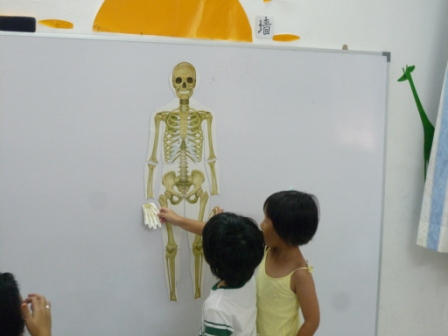
The older children were good at fixing the huge skeleton puzzle and labelling each bone.


The younger children were good at fixing the skeleton puzzle too under the guidance of Aunties. They were very excited especially moving from the concrete experience of Human-size skeleton to a huge 2-D puzzle.


Aunties will continue to teach other extensions of bones to the children doing craft and experiment in the next few weeks. The children are all looking forward to the activities!

Thursday, February 2, 2012

Young Musicians Emerge!

Our 5 to 8 year-olds completed their Kindermusik Young Child semester 2 last December. It had been a great semester as children started to play melodies on their glockenspiels. Some of them told me that they even tried it on their piano, which made them excited. I could see the children were enjoying their fruit of labour – having to learn all the theories and took some time to build up their musical foundation in Semester 1. They are now more confident to play on melodic barred instrument and also with the strong foundation in music, they seem to be able to make music everywhere they go! (To see more of this blog, click here)